Fine-Line Floral Tattoo Ideas: A Guide to Choosing Your Flower
Choose the shape first. A flower tattoo becomes more personal when its rhythm, silhouette and scale suit the way you want to wear it.
It is easy to save a beautiful floral tattoo without noticing what you actually love about it. Is it the long stem? The loose petals? The contrast between a dark center and an almost empty outline? Those answers are useful even before you choose a flower.
This field guide starts with six botanical directions, then helps you turn one into a complete tattoo brief. It focuses on the design itself rather than assigning a fixed meaning to every plant. The drawing sheet shows concept studies to discuss with an artist.
A quick distinction: “floral” describes the subject; “fine line” describes an approach to the linework. You can have a fine-line rose that is spare and graphic or one that is more descriptive. Decide how much detail you want before deciding how small it should be.
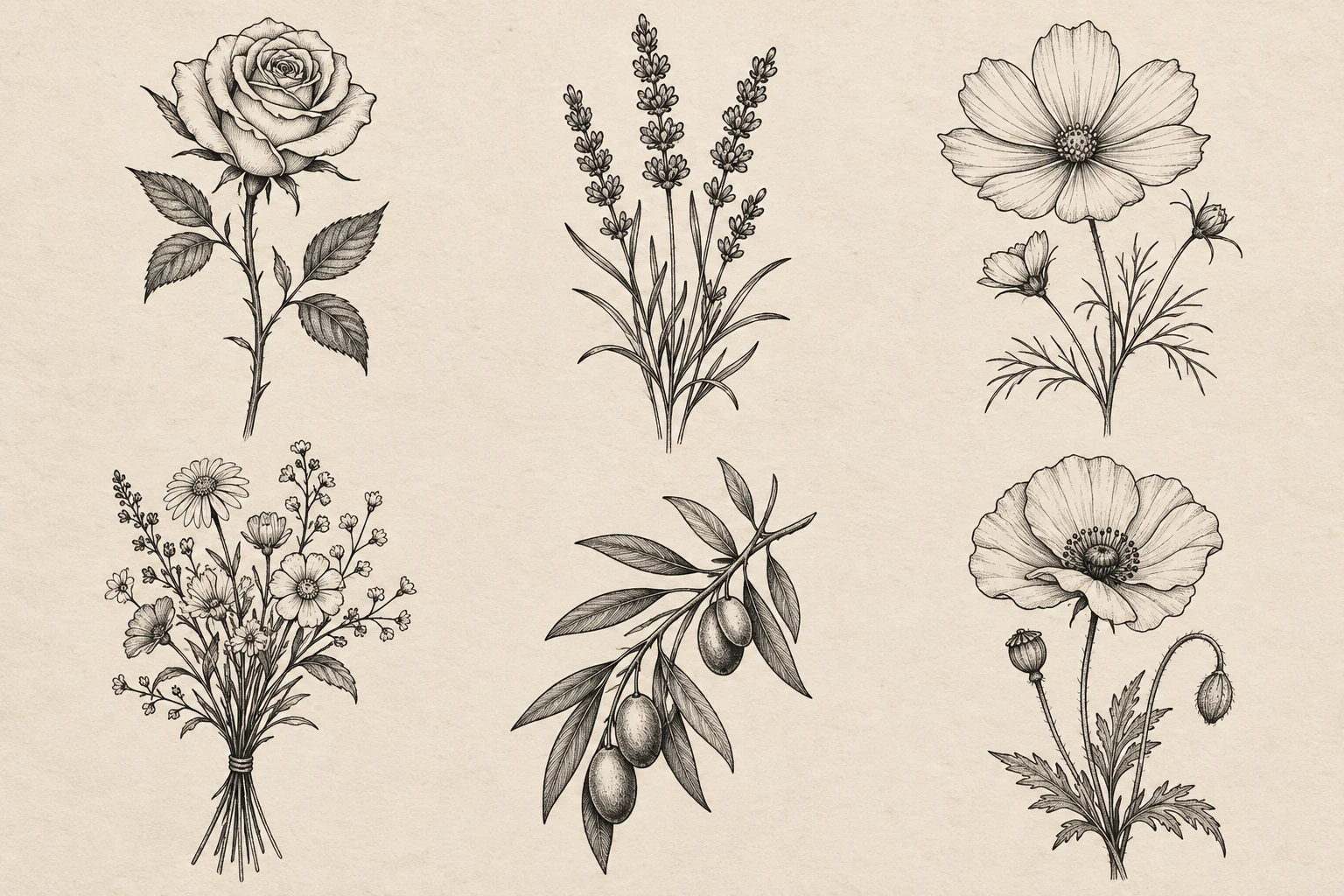
Six botanical directions
A single rose stem
A rose gives you a clear focal point at the top and a long line below it. You can use a tightly curled bloom for a compact composition or a more open flower for a fuller one. The stem can be straight, gently bent or interrupted by a small pair of leaves.
What to simplify: the folds inside the bloom. A handful of well-placed curves can suggest petals more clearly than a dense spiral of tiny lines.
Personal direction: use a reference from a garden or bouquet you remember, or choose the flower because you like its geometry. The emotional story can be yours without appearing as text.
A lavender sprig
A narrow sprig creates a quieter composition than a round flower head. Let the clusters sit at slightly different angles instead of drawing a perfectly repeated ladder. A gentle curve can make the stem feel more organic along a forearm or beside the ankle.
What to simplify: the individual buds. A readable cluster is more useful than a large number of dots compressed into a small space.
Personal direction: a single sprig can recall a place or a seasonal ritual. Adding several branches changes it into a fuller botanical study.
A cosmos bloom
Broad, open petals create a different rhythm from the layered rose. A slightly uneven outline can preserve the flower’s character. Give the center enough definition to anchor the shape, while leaving the petals relatively airy.
What to simplify: repeated lines inside every petal. Choose a few folds that explain the direction of the bloom and leave the rest open.
Personal direction: face the flower toward the viewer for a graphic shape, or angle it sideways for a more observational, sketchbook feeling.
A loose wildflower bouquet
A bouquet is about the relationship between plants. Pair one larger bloom with a smaller flower and a narrow sprig, then let their stems meet without turning into a dense knot. Different heights can keep the arrangement relaxed.
What to simplify: the number of species. Three distinct forms often tell a clearer visual story than a dozen miniature flower heads.
Personal direction: choose plants associated with people, places or occasions. If you want birth-month references, use our birth flower guide to begin the conversation.
An olive branch
A leafy branch gives you repetition without a large bloom. The leaves can alternate loosely along the stem, with some seen from the side. This option suits someone who wants a botanical tattoo but prefers a clean, elongated silhouette.
What to simplify: leaf veins. You may only need a clear outer shape and a restrained central mark to explain the plant.
Personal direction: keep it as a single branch, bend it into an open arc, or pair two short branches. Each composition changes the feeling even with the same plant.
A poppy with a bending stem
A poppy’s broad petals make room for loose linework. A dark center can provide contrast while the outer petals remain lightly described. The stem is part of the composition: a deliberate bend can make the whole piece feel less formal.
What to simplify: the delicate folds at the petal edges. Preserve the main shape before adding smaller gestures.
Personal direction: an open bloom feels expansive; a bloom with one bud beside it creates a quieter sense of progression.
Match the silhouette to the space
Think of your tattoo as a shape before thinking of it as a plant. A long stem, a round bloom and a branching bouquet need different kinds of room. The same flower can be redrawn to work in more than one format, but shrinking a large drawing is not the same as composing a small one.
| You want… | Start with… | Ask your artist about… |
|---|---|---|
| A narrow vertical piece | Rose stem, lavender or a leafy branch | The curve and where the visual weight sits |
| A small, rounded composition | One open bloom with a shortened stem | How much petal detail the scale can support |
| A piece that follows a curve | An arc of leaves or a leaning stem | How it changes when the body moves |
| A fuller focal point | A bouquet with varied flower heights | Keeping stems and flower heads distinct |
Decide what “delicate” means to you
For some people, delicate means very thin lines. For others, it means plenty of open skin, a small number of elements or a gently asymmetrical composition. You can ask for those qualities separately. That gives your artist more freedom to choose an appropriate line weight instead of treating the thinnest possible line as the whole brief.
Look at healed examples in the artist’s portfolio, including work at a similar scale. Ask how they would simplify the design and whether they recommend making it larger. There is no universal minimum size that works for every flower and every level of detail.
For color, decide whether it is central to the idea or simply an accent. One muted bloom with black stems has a different character from an entirely colored botanical drawing. Ask to see relevant healed color work rather than judging only from a fresh photo or an illustration.
Before you commit to the stencil
Check the design from your own view and from a mirror. Look at the space around it, not just the flower. If you want more tattoos later, consider whether the stem creates a useful boundary or cuts through an area you might want to fill.
Bring your favorite plant references and explain which parts matter. If a particular species is important, include a clear photograph. If the tattoo is about the overall botanical mood, allow the artist to adapt the shapes instead of forcing every reference into one piece.
For another airy subject, see our butterfly tattoo gallery. If you are assembling several individual pieces, our patchwork sleeve guide helps you think about their relationship.
Further reading: 71studio’s discussion of minimalist and floral tattoo design.