Butterfly Tattoo Ideas: 12 Designs, From Minimal to Bold
One motif, many moods. A butterfly can be a quiet outline, a graphic black silhouette, or the beginning of a larger botanical composition.
The shape is familiar, but the choices inside it make a surprisingly big difference. Open wings feel balanced. A side view feels lighter and more directional. Two butterflies create a small story. Before collecting twenty references, decide which of those qualities attracts you.
This gallery moves from restrained designs to bolder compositions. Use the ideas to describe what you like to your artist, rather than asking for someone else’s tattoo to be copied. The illustrations are design concepts, not examples of healed work.
Start with the silhouette
1. The open-wing outline
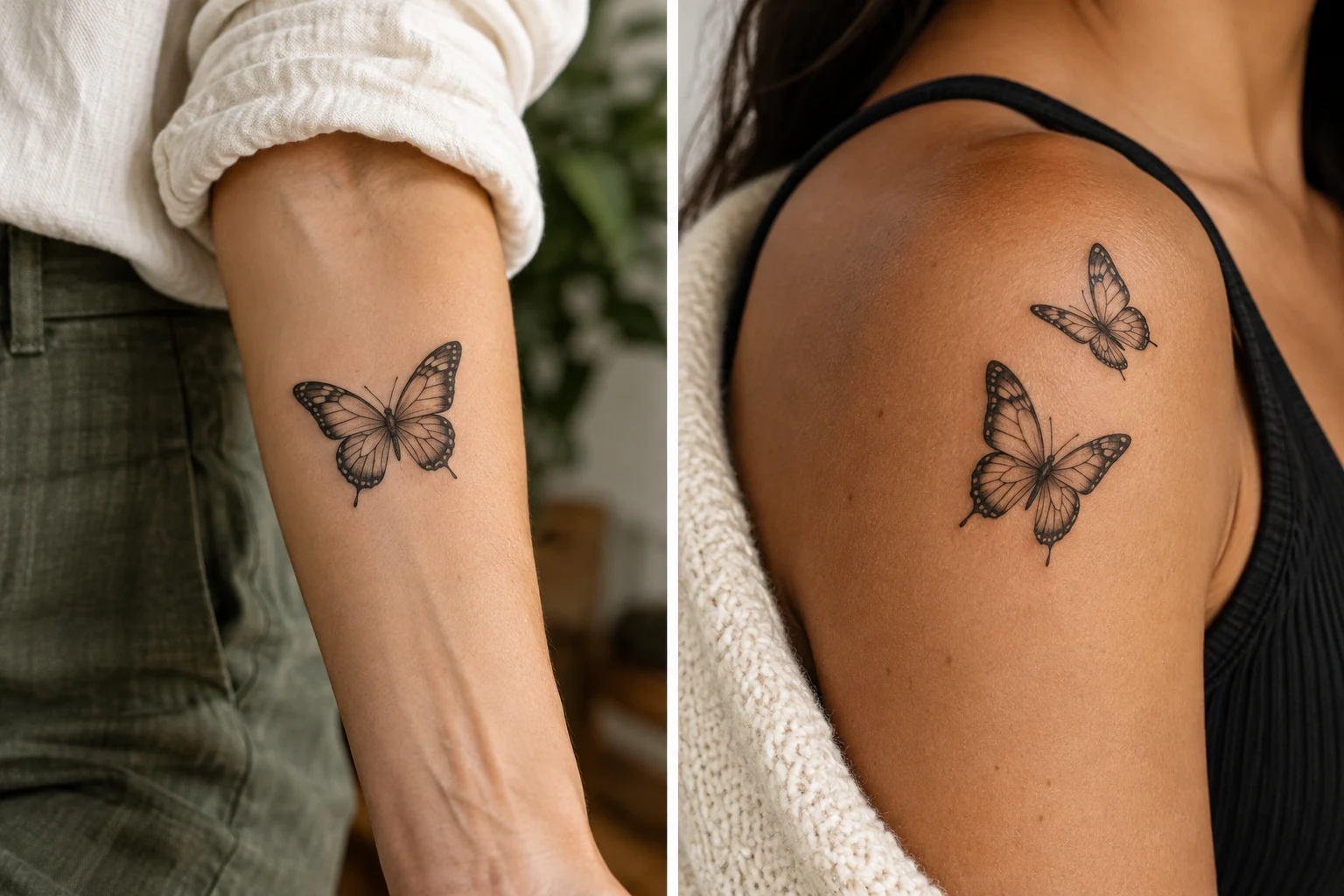
A clean outline lets the butterfly read without elaborate wing patterns. Keep the upper and lower wings distinct, with a little open space between the curves. An inner forearm placement makes the symmetry easy to appreciate; a shoulder placement gives it a softer relationship with the body.
Make it yours: choose rounder wings for a gentle look or more angular edges for a graphic one.
2. A butterfly in profile
Showing the wings from the side creates an almost leaf-like shape. It works beautifully when you want the design to lean or drift along the arm instead of sitting like an emblem. A small visible body keeps the image recognizable without filling the wing with tiny marks.
Design decision: a slightly tilted body can suggest movement even when the rest is simple.
3. A compact black silhouette
A filled butterfly has a different personality from a fine outline. It feels like a punctuation mark: crisp, visible and direct. Keep the gap between the wings clear. If the silhouette is too condensed, the subject loses the graceful shape that made you choose it.
Try: one on the upper arm, with enough surrounding space to let it stand alone.
4. Two butterflies taking flight
A pair gives you movement without needing a large tattoo. Make them different sizes or angles, and let the distance between them do some of the work. Two identical butterflies lined up evenly can feel more like a repeated stamp than a flight path.
Personal angle: the pair might recall a relationship or a shared moment, but it does not need an explanation.
Let one detail lead
5. A butterfly with restrained wing markings
Use a handful of clear veins or patches instead of trying to include every detail of a reference photograph. The outline should still lead. Bring a species reference if accurate markings matter to you, and ask your artist which features can survive the size you want.
6. Butterfly and single flower
A small bloom gives the butterfly somewhere to land. Keep the flower a little simpler than you first imagine: one open face, a short stem and perhaps one leaf. You can angle the butterfly toward the flower so the two elements feel connected without touching.
7. A butterfly with a crescent
A crescent can frame one wing or sit below the body. Choose which shape is the main subject; making both equally detailed often creates competition. A clean moon with a more descriptive butterfly gives the eye a clear route through the design.
8. An asymmetrical botanical wing
One wing can keep its butterfly shape while the other opens into leaves or petals. The challenge is balance. Instead of adding a full bouquet on one side, repeat the original wing’s outline through the position of the flowers. That keeps the concept readable from a distance.
Give the design room
9. An etched butterfly
Short hatch marks and selective dark areas create a print-like appearance. This is a good direction if you love antique illustration but want something less soft than a botanical sketch. Leave areas of untouched skin between the marks, and let your artist set a workable scale.
10. A butterfly inside an open frame
A broken oval, loose circle or simple rectangular corner can turn the motif into a small composition. Avoid a frame that hugs the wings too closely. The border should make the butterfly feel more intentional, rather than trapping it inside a crowded box.
11. A color-led butterfly
Choose a limited palette and a recognizable outline. A muted rust-and-black butterfly feels different from a blue one with almost no internal detail. Look at an artist’s healed color work on skin similar to yours when possible; a digital color study is a starting point, not a prediction of the result.
12. A butterfly anchoring a larger piece
For a shoulder or upper-back composition, the butterfly can be the focal point among stems, leaves or decorative curves. Start with the butterfly’s size and direction, then build around it. If every element is equally prominent, the tattoo can become busy even when each individual detail is delicate.
Placement changes the mood
| Placement | Design direction | Check at the stencil stage |
|---|---|---|
| Inner forearm | Balanced outline or profile | Which direction you want it to face when your arm rests |
| Shoulder | Pair in flight or larger open wings | How the wings follow the curve from front and side |
| Ankle | Simple silhouette or one clear outline | Whether the scale still reads beside your usual shoes |
| Upper back | Central butterfly or botanical composition | How much surrounding space you want to leave |
No placement is automatically right for everyone. Compare the stencil with your usual posture and clothing, and view it from more than one angle. A pleasing close-up is only one view of the finished composition.
Three choices to bring to your artist
- Mood: understated, naturalistic or graphic.
- Composition: one butterfly, a pair, or a larger arrangement.
- Priority: the silhouette, species detail, or a personal accompanying symbol.
Bring a small selection of references and explain what you like in each: the wing shape in one, the shading in another, the placement in a third. Your artist can then draw something coherent rather than trying to combine every saved image.
If you prefer a decorative direction, explore ornamental tattoo ideas. For the botanical side, read our fine-line floral guide.