25 Ornamental Tattoo Ideas That Look Like Jewelry
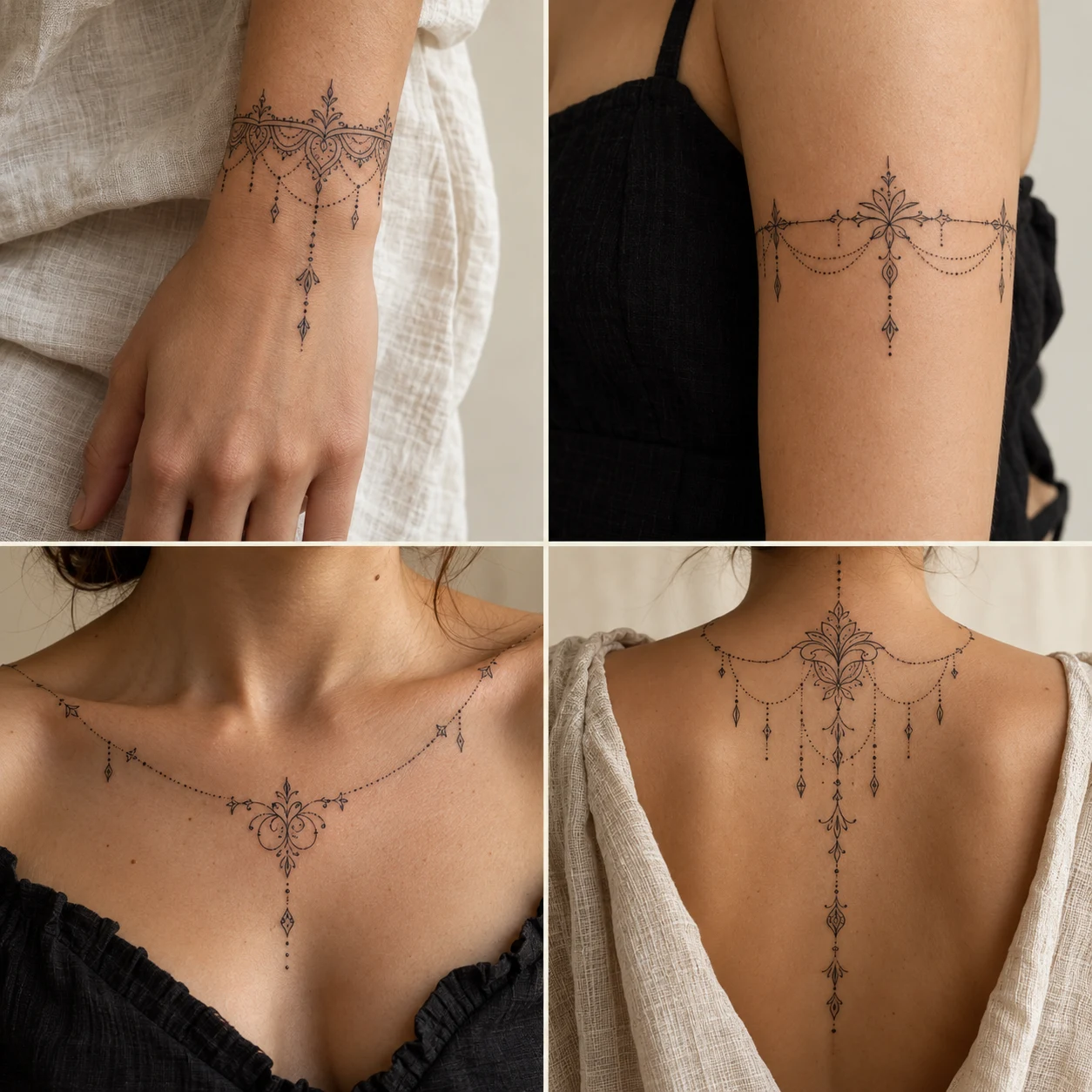
A bracelet you never take off. A pendant that follows the collarbone. A lace-like flourish across the back. Ornamental tattoos borrow the shapes of jewelry and decorative art, turning curves, dots and repeating patterns into something you can wear on your skin.
The most appealing designs have a clear silhouette and room to breathe. These 25 ideas are starting points for an original design with your tattoo artist, from subtle everyday accents to larger statement pieces.
What makes a tattoo ornamental?
Ornamental describes a decorative approach rather than one fixed motif. Repeated curves, botanical flourishes, scalloped borders, geometry and dotwork can all be part of it. Jewelry-inspired designs often use draped lines or pendant shapes, while others echo lace or decorative metalwork.
Some decorative traditions have specific cultural or religious meanings. If a reference comes from one of those traditions, learn its context and discuss it with an artist familiar with that work.
Wrist and forearm: everyday adornment
01. A fine chain bracelet
A narrow chain around the wrist creates the feeling of an everyday bracelet. Leave a small opening rather than closing the circle completely, or add one pendant as a focal point. Ask your artist how the design will sit when your wrist bends.
02. A single pendant drop
One teardrop or oval suspended from a short line looks understated on the inner forearm. Keep the outline simple and give the pendant enough space to remain readable. It can suggest a favorite necklace without copying it literally.
03. A botanical cuff
Two curved leafy branches can frame the wrist like a cuff. Let the ends taper instead of packing leaves tightly together. An open cuff is a good starting point if you want ornament without a full band.
04. An Art Deco fan
A small fan of geometric rays brings a more structured feel to ornamental work. It suits an elongated forearm composition, especially with one strong central line. Choose a few clear shapes rather than dozens of miniature details.
05. A dotted pearl strand
Spaced dots can suggest pearls along the side of the forearm. A subtle arc feels more natural than a rigid row. Think of the dots as part of the composition, with deliberate spacing and a clear beginning and end.
Collarbone and shoulder: delicate framing
06. A collarbone garland
A light botanical garland can echo the curve beneath one collarbone. Asymmetry keeps it relaxed: a longer branch on one side and a short trailing sprig on the other. Test the placement with the necklines you wear most often.
07. A tiny ornamental medallion
An oval medallion with a simple border feels like a small keepsake. Place it near the shoulder or below the collarbone, leaving room around it. A personal initial can be added if the artist recommends a size that keeps it legible.
08. A shoulder filigree crescent
Curving filigree can wrap gently around the shoulder cap. A crescent-shaped composition follows the area better than a flat rectangular panel. Pick one repeating curve and let it carry the design.
09. A ribbon and pendant
A softly looped ribbon with one pendant combines ornamental and romantic elements. Avoid making every fold equally detailed; a strong outer silhouette gives the piece its character. This can work as a vertical design on the upper arm too.
10. A draped chain accent
Two or three open arcs can look like a chain resting across the shoulder. Use restraint with hanging details so the curves stay visible. Check the stencil with your arm both relaxed and raised.
Back: a statement with breathing room
11. An upper-back necklace
A shallow ornamental arc across the upper back can resemble the back of a necklace. A small central drop anchors the shape. The design does not need to reach both shoulders to feel complete.
12. A vertical botanical spine piece
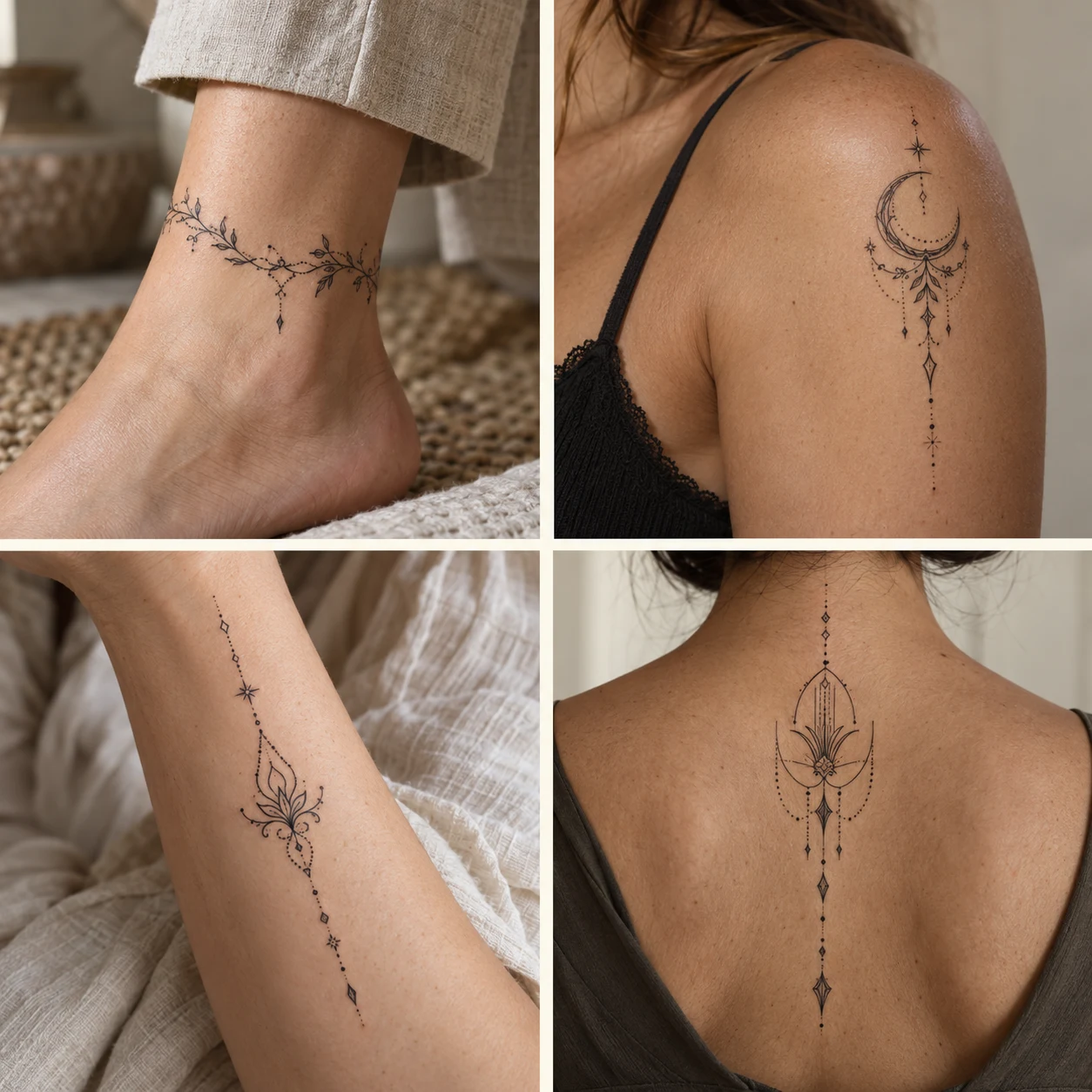
An elongated branch with ornamental flourishes creates a vertical rhythm. Alternate fuller sections with open space instead of filling the entire length. Decide whether you want strict symmetry or a freer botanical arrangement.
13. A lace-inspired back panel
Use the rhythm of lace—scalloped edges and repeated loops—as inspiration for an original panel. Simplifying the pattern can make it more readable on skin. Bring references for texture and mood, then let your artist redraw the composition.
14. A symmetrical lower-back flourish
Two outward-facing curves with a clear center create a balanced lower-back design. It can be botanical, geometric or purely decorative. Try the stencil while standing naturally so the balance relates to your body rather than a photograph.
15. An ornamental butterfly frame
Instead of covering a butterfly in tiny detail, surround a simple silhouette with a few elegant flourishes. The frame creates the jewelry effect while the butterfly remains recognizable. Give both elements enough space to stand on their own.
Ankle and upper arm: smaller pieces
16. An open anklet
A fine curved line with a small charm can suggest an anklet without wrapping all the way around. Place the focal point where you want it visible from the front or side. Take everyday footwear into account when discussing the placement.
17. A trailing ankle vine
A short vine that rises from the ankle feels like an accessory with movement. Keep a few leaves and one decorative curl rather than a dense tangle. It also adapts well to a slightly larger calf design.
18. A double-line arm cuff
Two separated lines with one ornamental bridge make a clean cuff. The space between the lines matters as much as the lines themselves. Choose whether it should be visible from every angle or appear as an open accent.
19. A miniature chandelier
A small central shape with two or three hanging drops has a chandelier-like silhouette. The upper arm gives the design room to breathe. If you prefer a tiny tattoo, simplify the number of drops instead of shrinking a complex drawing.
20. A vintage key ornament
A decorative key can bring a keepsake quality to the composition. Focus on a distinctive bow at the top and a clear stem. Personal meaning can come from your own memory rather than a fixed symbolic interpretation.
Personal details: make the ornament yours
21. A birth-flower pendant
Set your chosen birth flower inside a simple pendant outline. This combines botanical symbolism with an ornamental frame. If the flower needs more detail, increase the pendant size rather than compressing the petals.
22. A crescent with hanging beads
An open crescent with a few suspended dots feels celestial and decorative. Keep the silhouette clear and choose unequal drop lengths for a gentle rhythm. The meaning can be entirely personal; the shape does not need a universal explanation.
23. An initial inside a frame
One letter in a plain ornamental border can feel like a monogrammed piece of jewelry. Compare a few lettering styles at the actual tattoo size. Intricate script and intricate framing can compete, so let one element stay simple.
24. A gemstone outline
A diamond, oval or pear-shaped outline with a few facet lines suggests a gemstone. Black ink keeps it graphic; color is another option to discuss with your artist. Choose a stone shape you like rather than assuming it must represent a particular month.
25. An asymmetrical charm collection
Combine two or three original motifs in a loose arrangement: a leaf, a star and a pendant, for example. Repeat a line weight or border style to connect them. Leave room if you think you may want to add another charm later.
How to choose a design you will enjoy wearing
Start with the placement. Think about visibility, your usual clothes and whether you want one isolated piece or space for a future collection. A design that looks balanced on a flat reference may need adjustment on a moving body.
Test the stencil at the actual size. Look in a mirror from more than one angle. For bracelet and cuff designs, check the shape with the limb relaxed and bent. Take time to decide before the tattoo begins.
Ask to see healed examples. Fresh photographs are useful for composition, but healed work helps you understand the artist’s approach over time. Ask how much spacing and line weight your particular idea needs; there is no single best size for every design.
Use references as a brief. Save the curves, balance or mood you like, then ask for an original drawing. You can borrow the idea of a pendant without reproducing someone else’s tattoo.
Frequently asked questions
Can an ornamental tattoo be small?
Yes, especially with one clear motif such as a pendant, open cuff or simple flourish. A tiny version of a complex lace panel may lose the visual spacing that makes the original appealing. Let your artist recommend an appropriate scale.
Does an ornamental tattoo need a meaning?
No. Enjoying its shape is enough. If you want something personal, a flower, initial or keepsake-inspired detail can make the ornament feel connected to your own story.
Will fine ornamental detail stay exactly the same?
Tattoos change over time, and results vary by design, technique, skin and placement. Ask your artist about spacing and healed examples rather than relying on a freshly photographed tattoo as a promise.
Can I combine ornamental and botanical styles?
Yes. Leafy cuffs, flower pendants and vine-like back pieces are natural combinations. Choose which element leads the design so the final piece feels intentional.
More tattoo inspiration
For a personal botanical detail, explore birth flower tattoos for every month. For a smaller starting point, see our 35 meaningful small tattoo ideas or 40 behind-the-ear tattoo ideas.
Save the designs that catch your eye, then refine the placement, scale and details with your artist. The best jewelry-inspired tattoo should feel like something you chose for yourself.