Patchwork Tattoo Sleeve Ideas: How to Build a Collection That Fits
You do not need to choose an entire sleeve at once. You do need to think about the space between the pieces.
A patchwork sleeve is a collection of individual tattoos arranged across an arm rather than one continuous background or scene. Each piece has its own outline. The collection can grow over time, with visible skin helping separate the designs.
The appeal is freedom: a shell from one chapter of life, a flower from another, a graphic symbol chosen simply because you love it. The challenge is making those separate choices sit comfortably together. This workshop walks through the decisions that help, from the first anchor piece to the last small gap.
Choose a visual rule you can keep
A collection does not need one subject to feel coherent. It can share a line weight, palette, drawing approach or balance of dark and open areas. Pick one or two rules that actually fit the designs you enjoy. Too many restrictions can make a personal collection feel like a matching set.
The graphic black collection
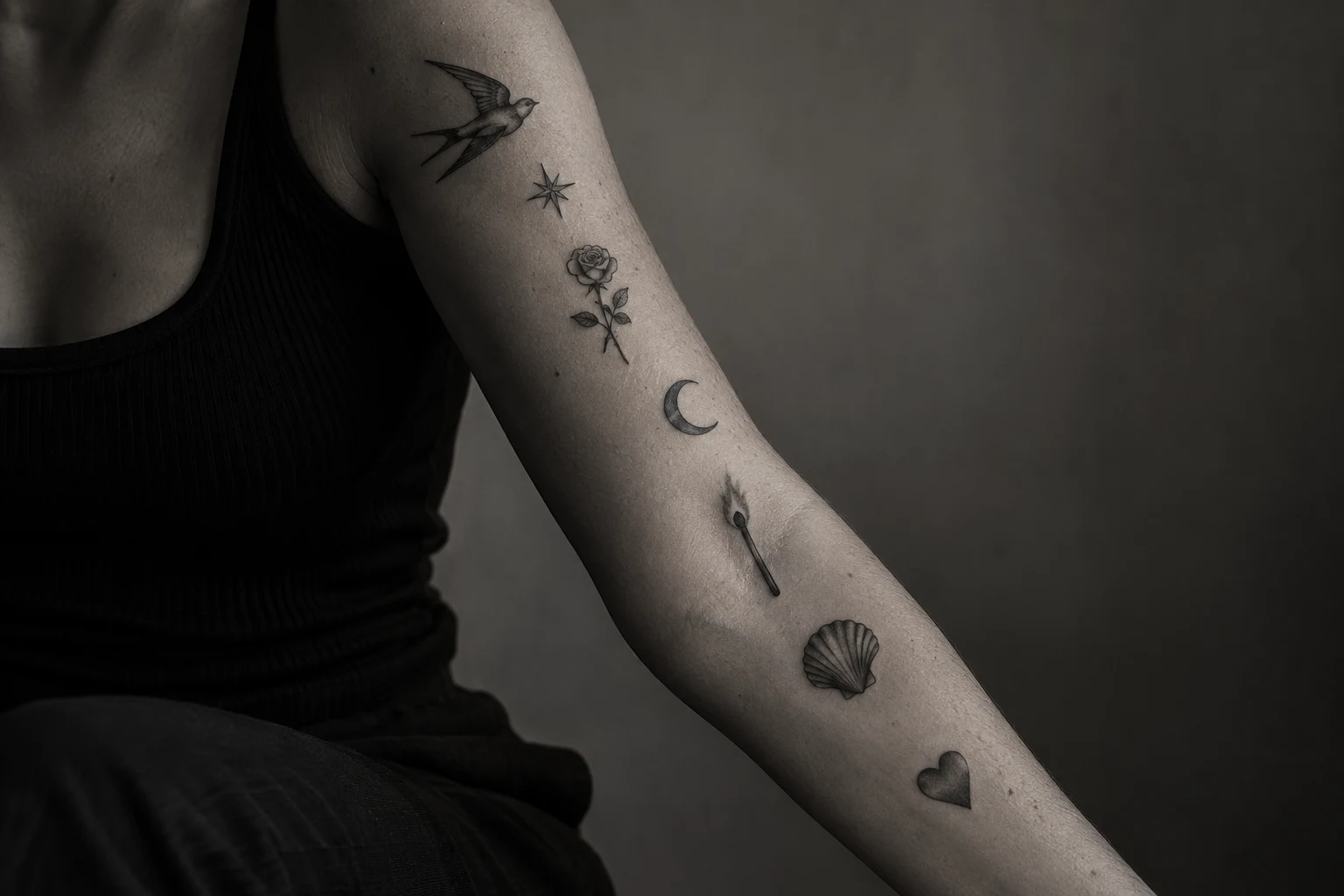
Start with clear silhouettes: a small swallow, a star, a shell and a heart. Keep their sizes varied so the arm does not look like a grid of equal stickers. One more detailed piece can provide interest while the simpler shapes hold the collection together.
The botanical sketchbook
Combine individual flowers, a leaf cluster, a moth and perhaps a small fruit. You can repeat a restrained shading approach without giving every piece the same stem or border. Let each motif retain its own shape.
The bold illustrative collection
Choose designs with clearer outlines and selected filled areas: a rose, a bird, a small torch or an everyday object. The connection can be the drawing language rather than the meaning of each piece.
The personal object archive
Collect things tied to memories: a cup, a key, a seashell, a small book or a match. Decide whether you want them rendered as spare outlines or more descriptive illustrations. That common approach helps unrelated subjects feel intentional.
Mixing styles is possible. The useful question is what connects them. If you want both delicate botanicals and bold black shapes, show your artist the combination early so they can think about contrast across the arm.
Give the strongest pieces the best spaces
An anchor is a tattoo that sets the scale or mood of the collection. It does not have to be huge. It simply has more visual presence than the small accents around it. Choose the pieces you care most about before filling every easy gap.
Imagine the arm in zones: shoulder and upper arm, outer forearm, inner forearm, and the smaller connecting areas. These are planning zones, not boxes that need to be filled. A longer piece may travel between them. A rounded piece may sit comfortably on one surface.
A practical starting arrangement might be a bird on the upper arm, a rose on the outer forearm and a small shell on the inner arm. The subjects differ, but the first two establish a scale that can guide future additions. You can keep other areas open until you find designs you care about.
Treat the empty skin as part of the design
There is no one spacing measurement that suits every patchwork sleeve. A loose collection may use generous gaps; a dense one may leave narrow channels. What matters is whether the spaces help the individual tattoos remain readable.
Pay attention to the shapes of those gaps. A row of narrow vertical tattoos can leave a long corridor that feels accidental. Several round motifs of the same size can create a repetitive arrangement. Changing one piece’s size, angle or position may solve more than adding another tattoo.
| If the collection feels… | Reconsider… | A useful adjustment |
|---|---|---|
| Too uniform | Repeated sizes and angles | Introduce a larger anchor or a different silhouette |
| Visually heavy on one side | Where filled black areas sit | Balance the composition with an open piece or reserve room elsewhere |
| Crowded | Whether every gap needs a tattoo | Keep a deliberate channel of empty skin |
| Disconnected | Your shared visual rule | Repeat a drawing style or palette in the next few pieces |
Use paper mockups or an artist’s placement sketch to compare arrangements. The point is to test relationships, not to predict exactly how a finished tattoo will look. Bring the layout to someone who can adapt it to your arm.
Add pieces in an order that leaves choices open
Begin with a design you want even if the sleeve never becomes full. Then make the next addition with the existing piece in mind: its scale, direction and darkest areas. This is more useful than choosing every new tattoo in isolation.
Save smaller fillers for later. A star, short sprig or simple shape can fit a narrow space, but adding them too early may use a location that would have suited a more important piece. Empty space can remain empty. A sleeve does not become better simply because it becomes denser.
If you already have tattoos, use them as the starting map. A new collection can work around an older piece without pretending it was all planned from the beginning. Ask your artist which areas have room for anchors and which would benefit from restraint.
A sleeve idea to adapt, not copy
Picture a black-ink collection with a swallow as the upper-arm anchor, a rose lower down, and a shell on the inner forearm. Add a crescent, a small heart and a match in different orientations. Leave the elbow area and a strip between the larger pieces open until you can see how the collection feels.
That is a composition exercise rather than a formula. You might replace the swallow with a butterfly, the rose with a poppy, and the match with a meaningful object. The useful part is the hierarchy: a few stronger pieces, several quieter ones and space that connects them.
Bring this brief to the consultation
- Existing pieces: clear photos from several angles.
- Direction: loose or dense, mainly open linework or more black fill.
- Non-negotiable subjects: the two or three designs you most want.
- Future room: any area you want to reserve for a larger piece.
- Questions: suggested order, placement options, session planning and a quote for the actual work.
Costs depend on the artist, location, individual designs and the sessions needed. A sleeve total guessed from the number of motifs can be misleading. Ask how the work is priced and what is included, then decide on a pace that fits your budget.
The question that keeps a collection personal
Before each addition, ask: would I want this tattoo if it were the only one on my arm? If the answer is yes, it has a reason to be there beyond filling space. Then ask how it relates to what you already have. Those two questions help balance personal choice with the composition of the whole sleeve.
Explore our fine-line floral guide for botanical pieces or the butterfly gallery for a potential anchor. For individual symbols, browse meaningful small tattoo ideas.
Further reading: Tuff Tattoos on patchwork collections and sleeve planning.