Dragonfly Tattoo Ideas: Two Beautiful Directions, From Airy to Bold
A dragonfly tattoo has a built-in sense of movement: four wings, a narrow body and a shape that seems to hover. You can make that silhouette quiet and delicate or give it a stronger graphic presence. The useful question is which version feels like you.
Start with the wings, not with an extra symbol. Their spread determines how the design fits the body and how much room the details have. A broad, open dragonfly and a compact, dark one can express the same personal story while looking completely different.
The airy version: let the wings do the work
A fine-line dragonfly feels light when each wing has a clear outer edge and only a few internal lines. The open skin is part of the drawing. Resist the urge to fill every wing with a lace-like network simply because the insect has intricate wings in nature.
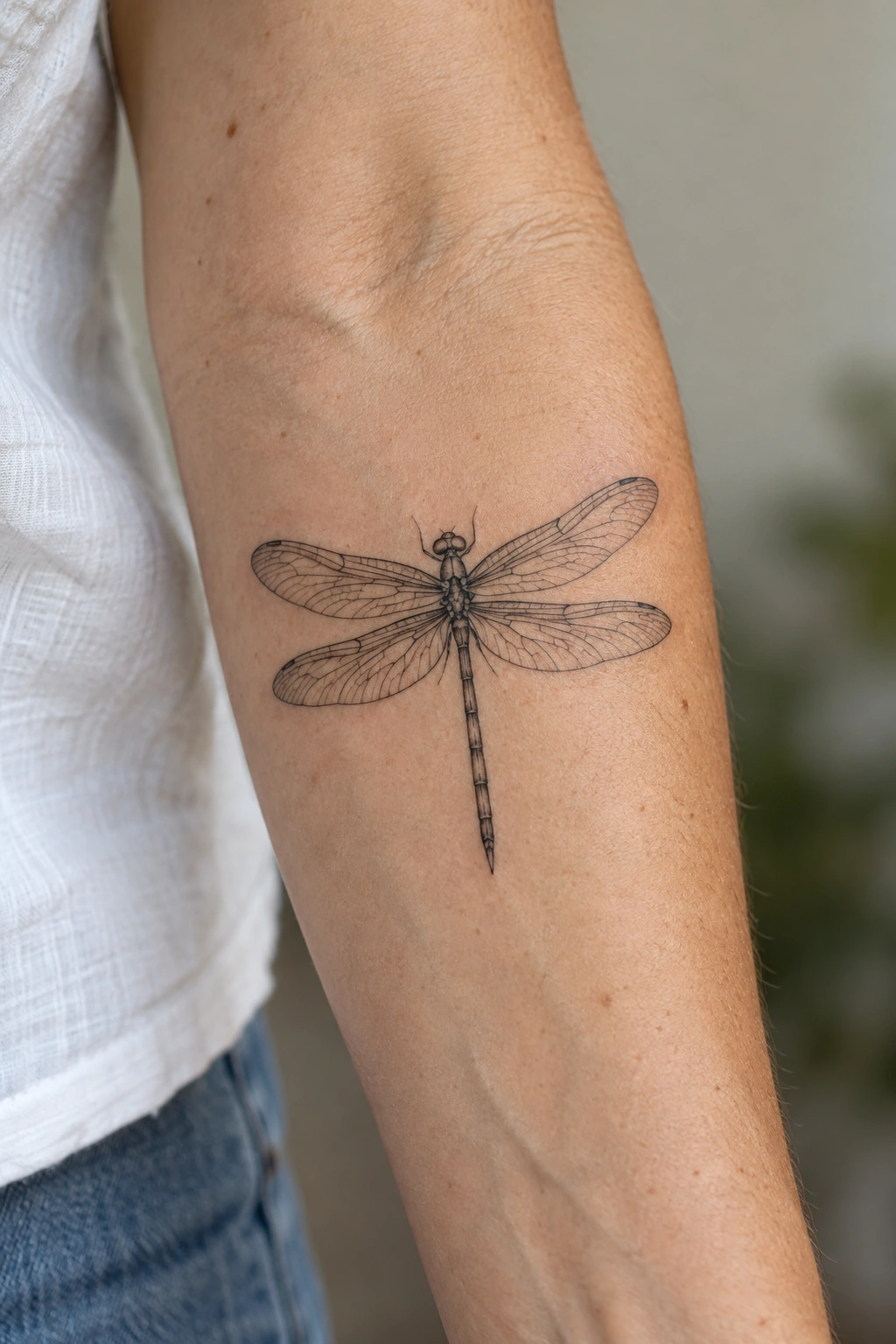
The forearm gives you room to see the whole wingspan without having to turn your body toward a mirror. Compare a centered stencil with a slightly angled one. A small angle can suggest flight, while a centered shape can feel calm and balanced.
The detail worth protecting: the separation between the upper and lower wings. Ask the artist to show how those gaps look at the final size. A drawing that is beautiful when enlarged on a screen can become crowded when reduced to a few centimeters.
For a personal variation, choose the direction of flight rather than adding several decorations. A dragonfly facing toward the hand feels different from one directed toward the elbow. Photograph both stencil orientations before deciding.
The graphic version: a stronger body and quieter wings
A bolder dragonfly can use a darker segmented body, selective black areas and a little dotwork around the wing roots. This creates contrast without turning the entire insect into a solid patch. The outline should remain readable before you notice the texture.
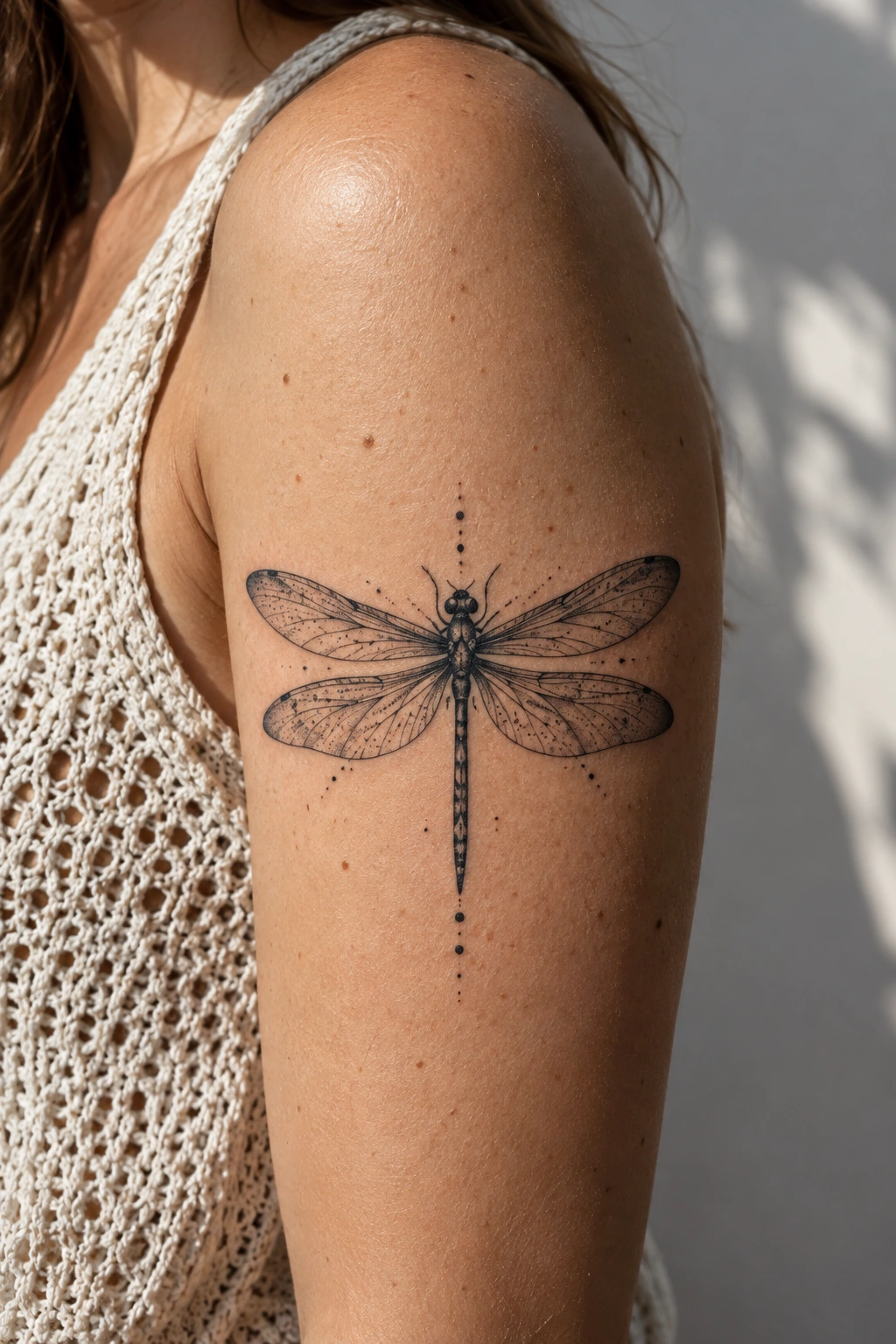
The outer upper arm can suit a broad composition because the wings have a relatively wide surface to occupy. Check the stencil from the front and side. A wing that disappears around the arm might create movement you like, or it might interrupt the symmetry you wanted.
The detail to edit: unnecessary tiny dots at the tips. A few intentional shaded areas can have more impact than a uniformly busy pattern. Ask the artist what they would remove if the size needed to be slightly smaller.
This direction can work well beside existing blackwork. Compare the line weight with the tattoos already nearby, and leave a clear breathing space between pieces instead of trying to make every edge touch.
Fine line or bold: a quick decision guide
- You want a light, visible outline
- Begin with the airy option. Choose an artist whose healed work shows clean wing edges and clear gaps.
- You want a design you can recognize from farther away
- Start with the graphic option. Discuss the main silhouette before choosing the amount of shading.
- You want the smallest possible tattoo
- Ask which details can be simplified. The sensible size depends on the drawing and technique; there is no single measurement that suits every dragonfly.
Bring a short brief, not a finished tattoo to copy
A helpful consultation message names the subject, the mood and the placement: “A four-winged dragonfly on my forearm, with a light outline and very little shading.” Add approximate dimensions and a few references for the feeling you like. Let your tattooer draw an original composition for your body.
If you are deciding between insect motifs, compare the wing shapes in our butterfly tattoo guide. For a more decorative approach, our lace-inspired moth ideas show how a patterned wing changes the mood.
Further reading: 3 of Spades Tattoo’s dragonfly guide offers studio context on the motif. The two images here illustrate original design directions.